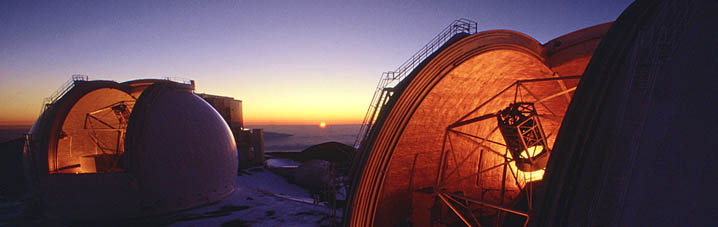
The Call for Proposals for NASA time at the W. M. Keck Observatory (WMKO) in observing semester 2026B (August 1, 2026 to January 31, 2027) is now open.
The opportunity to propose as a Principal Investigator (PI) for NASA time on the Keck Telescopes is open to all U.S.-based astronomers (i.e., those whose principal affiliation is at a U.S. institution).
The NASA-Keck Time Allocation Committee (TAC) uses a Dual Anonymous Proposal Review (DAPR) process. Proposers prepare two documents: an anonymized Science Program and a non-anonymized Expertise and Access document.
(last updated May 14th, 2026 09:55:51)
NASA announces this Call for Proposals to use its share of observing time at the W. M. Keck Observatory. This Call is for semester 2026B (August 1, 2026 to January 31, 2027). Allocated nights will be distributed evenly across dark, grey, and bright time. The oversubscription rate is typically ~5:1.
Proposals are due on Thursday, March 12, 2026 at 4 pm PT and should be submitted via the online submission site. All proposals are required to use these templates for the Science Program (available in Word and LaTex format) and the Expertise and Access document (available in Word and LaTex format).
NASA intends the use of its time allocation on the Keck telescopes to be highly strategic in support of on-going missions and/or high priority, long-term science goals as described in the Science Mission Directorate's 2020 Science Plan and in the documents linked below for each science area.
The scientific areas in which proposals are solicited are:
Proposers are also encouraged to consider compelling investigations supported by the recent Decadal Survey on Astronomy and Astrophysics 2020 (Astro2020) or the Planetary Science and Astrobiology Decadal Survey 2023-2032. Proposers should identify how the observations contribute to the body of scientific knowledge needed to help refine objectives of future missions and aid in the understanding of the targeted scientific area. Observations should be of lasting importance to the broader Astrophysics and Planetary Science community.
Proposers should base their science case in terms of strategic relevance toward achieving one or more of NASA's goals in the science areas listed above. Gradations of strategic relevance are listed below from strongest to weakest. In the "NASA Strategic Relevance" section entered on the submission site, please note and give evidence for the level your program matches. A numerical grade that counts for 40% of the overall grade will be assigned for strategic relevance.
GO and Mission Support programs requiring several nights of Keck time over multiple semesters (up to four) may be submitted, but must explicitly justify their strategic connection to the stated goals. More information about multi-semester proposals can be found in Section III.
Within these broad guidelines, the allocation of time will be based on scientific merit, strategic importance, resource availability, and the uniqueness of Keck's capabilities for the investigation. All proposals for NASA-Keck time will be evaluated by scientists on the NASA-Keck TAC, with the TAC process administered by the NASA Exoplanet Science Institute (NExScI). In recognition of the science communities that NASA-Keck time serves, TAC members are selected to ensure balanced expertise in the areas of exoplanets, solar system objects, and in support of the NASA Cosmic Origins and Physics of the Cosmos goals. NASA's proposal solicitation and their evaluation by the NASA-Keck TAC are phased to meet the telescope scheduling requirements set by the Director of the Keck Observatory.
The opportunity to propose as a Principal Investigator (PI) for the NASA time on the Keck Telescopes is open to all U.S.-based astronomers, i.e. those with their principal affiliation at a U.S. institution. All proposals for NASA-Keck time must comply with the criteria outlined in the following sections. The NASA-Keck proposal review follows a Dual Anonymous Proposal Review (DAPR) process.
Compliant proposals received by the application deadline will be reviewed and ranked by the NASA-Keck TAC. The TAC will submit their recommendations to the selecting official, the NExScI Executive Director, for final selection. NExScI will coordinate the final selections with WMKO for scheduling.
For a complete NASA-Keck proposal, PIs will submit the following documents as well as the information requested on the submission site.
| GO proposals | KSMS proposals | HWO proposals | |
| 1. Science Case | up to 2 pages | up to 5 pages | up to 2 pages |
| 2. Instrument Request | up to 1 page | up to 2 pages | up to 2 pages |
| 3. Data Reduction and Release Plan | N/A | up to 1 page | up to 1 page |
| 4. Mission Support Justification | up to 1/2 page if applicable | up to 1 page | up to 1 page (HWO relevance justification) |
| 5. Figures and Tables | up to 1 page | up to 2 pages | up to 1 page |
| 6. References | up to 1 page | up to 1 page | up to 1 page |
| Total Science Program Page Count | up to 5 1/2 pages | up to 12 pages | up to 8 pages |
| 7. Target List | no limit | no limit | no limit |
Proposals that violate the page limits will be evaluated solely on the information on the allowed pages and will likely receive a lower ranking from the TAC. In extreme cases the proposal will be returned as non-compliant.
Proposal Submission
Proposers should submit PDFs of their Science Program and Expertise and Access Document using the online proposal submission site which includes fields for:
All these fields should be written in DAPR format. Information on the NExScI cover page may be made public for accepted proposals.
Shortly after proposal submission, you will receive an email acknowledgement with attached PDFs of the anonymized and non-anonymized versions of your proposal as received at NExScI. Please email KeckCFP@ipac.caltech.edu if you do not receive the confirmation email or experience problems.
The Science Program should outline the science and technical case for the proposed program using this template available in Word and LaTex. These Guidelines for Proposers will assist with writing an anonymized proposal. The scientific case for observing time should establish the following:
The technical case should demonstrate that the proposed measurements are technically feasible, given the performance of the proposed instrument(s), in the time requested.
Specific points that must be addressed include:
Target List: A complete and well-justified target list with sufficient information (magnitudes, coordinates) to determine scheduling within the semester, including which part of the night is requested if asking for less than full nights, is required. Proposers should ensure that their targets are observable during the time period(s) they are requesting. Applications without such lists will be rejected. In the case of Target of Opportunity (ToO) targets or sources being drawn from on-going surveys (e.g., TESS) or very large samples of sources (e.g., from deep extragalactic fields), a description of the nature and location of the potential targets must be provided in sufficient detail for the TAC to make a thorough review.
The proposal should be aimed at someone who is not a specialist in the particular area of astronomy under study. A specific scientific case with a connection to the bigger picture, rather than a broad general one, is usually more successful with the TAC.
For a proposal to be recommended for scheduling, the proposal must have both a high science and a high strategic grade. The TAC evaluates the scientific merit of each proposal separately from the strategic merit, so successful proposals must present a strong and coherent scientific case.
As part of the DAPR process, proposers must also submit a non-anonymized Expertise and Access (E&A) document in addition to the anonymized Science Program. The E&A document must use this template available in Word and LaTex.
Team ExpertiseThe one-page team expertise document should demonstrate that the proposal team has the requisite expertise to make the observations and reduce the data in a timely manner. It should include the team's expertise in the following: Keck instrumentation, data reduction and analysis/modeling, and observational experience. For proposals with many Co-Investigators, it is not necessary to report on the qualifications of every team member, only those conducting or leading major aspects of the proposed study. A biography of each team member is not needed.
Access to Keck and Subaru TimeProposals from PIs, or any Co-Is, who have access to Keck or Subaru (if applying for Subaru time) telescopes through other partners, specifically the University of California, Caltech, Yale, Keck Observatory, Swinburne, and the University of Hawaii, are accepted by the NASA-Keck TAC (here, access applies to the PI an Co-Is, and not to the institution as a whole). However, the Expertise and Access document must specifically include:
Proposal ranking may be affected by access to non-NASA-Keck/Subaru time. The ability to achieve the science objectives with and without NASA time could be either a positive or a negative factor. If NASA time provides only a small fraction (<< 50%) of the observing time needed to complete a project, the TAC might conclude that NASA time is not crucial for project completion and the proposal may receive a lower ranking in comparison to a project that completes its goals within the NASA allocation. However, if the PI can leverage access to NASA and non-NASA time to address science aligned with NASA strategic goals that could not be addressed with NASA time alone, the proposal could receive a higher ranking. In the case of two proposals ranked equally on scientific and technical merit, the TAC might use access to additional Keck time as one of the factors in determining the final ranking.
Failure to account for your appropriate level of access to non-NASA-Keck time, both on the submission page and in the text of the E&A document, is grounds for proposal rejection.
Progress Report for Ongoing or Recently Completed Keck Projects AND Status of Allocated Time on Large TelescopesNo more than one page should be used to summarize the current involvement of the PIs and Co-Is on existing Keck research programs to inform the reviewers of the status of completed and planned observations, data analysis, and publications. A similar summary should be made for other relevant large or space-based telescope time that has been awarded during the past two years.
To use the NASA time on the Keck telescopes as efficiently as possible, proposers must verify, while being DAPR compliant, that their science goals cannot be met through public observations already in KOA. To do this, the PI must enter text into a box on the submission site explaining why data contained in KOA are not sufficient to meet their science goals.
Reasons why additional or different data are needed could be related to, but are not limited to, the cadence, timing, or depth of the archived observations, or the wavelength range or observation mode in which the data were taken. PIs proposing solar system or other target observations that investigate changes over time, can state this without checking the archive. Proposers with large survey programs should describe KOA results for a representative sample of their targets.
To see what data are contained in KOA, please use this link and enter your target list according to the directions.
HIRES is available in a dedicated precision radial velocity (PRV) configuration. Data collected in this HIRES-PRV configuration are compatible with the public radial velocity pipeline processing environment available at NExScI which will produce wavelength-calibrated 1D spectra and time series of relative PRVs.
There are important considerations for observers wishing to use the HIRES-PRV configuration; only data collected in the specified HIRES PRV configuration and data collected according to the documented recommendations can be processed properly in the NExScI HIRES processing environment.
The HIRES informal queue, led by the California Planet Search (CPS), will be available in 2026B. Inclusion in the queue will offer cadenced observations spread over all available HIRES nights, beyond individual PI allocated nights or night fraction. Reduced data products can be provided by CPS including fundamental stellar properties and precise radial velocities using the iodine technique. CPS collaborators will be required to join the CPS collaboration as collaborators and adhere to the CPS membership guidelines. Interested proposers must contact the CPS group at least two days prior to the NASA-Keck deadline (i.e., before Tuesday, March 10, 2026 at 4 pm PT) for a basic proposal review to prevent intellectual collisions and to ensure the proposed observations are achievable. Successful PIs will be requested to provide observers to assist with the collective observing that is proportional to their allocation. Further details on CPS are available here.
Applicants will be notified of the outcome of the proposal review in early June (B semesters) or early December (A semesters). Successful applicants are encouraged to initiate communications with the WMKO technical staff to ensure that valuable Keck telescope time is used efficiently from your first time on the telescope.
Program SupportContingent upon funding from NASA Headquarters, PIs of programs assigned time through this Call for Proposals will receive limited research and travel support. Funding awards will be determined through formulaic means. Target of Opportunity and Twilight Observing programs do not receive financial support since the observations may never be triggered.
NExScI will manage the Keck PI Data Awards (KPDAs) and will contract with the Jet Propulsion Laboratory (JPL) to administer the disbursement of most of the funds. Depending on the size of the award and the nature of the home institution of the PI, the funding instrument used by JPL will, in most cases, be a Research Support Agreement (RSA). An RSA is a simple Fixed Price, Advance Paid, subcontract provided through JPL that is used for basic research funding where scientific reports and technical data are the only deliverables. RSAs can be awarded to educational and non-profit institutions. Proposals should not include any budget information.
Final ReportThe only reporting necessary for KPDAs is a required "end of contract" report outlining the work done and any resulting publications. Please use this final report template to ensure that all relevant information is included. Failure to submit a final report in a timely manner may be grounds for rejection of observing proposals in subsequent years. Final reports should be submitted online.
In order for a proposal to be considered for Mission Support status, the proposing team must demonstrate that the proposed program meets one or more of the programmatic criteria below in the appropriate section of the anonymized Science Program.
For any type of mission support proposal to be recommended for scheduling, the proposal must have both a high science and a high strategic grade. The TAC evaluates the scientific merit of each proposal separately from the strategic merit, so successful proposals must present a strong and coherent scientific case.
The NASA-Keck TAC accepts General Mission Support proposals every semester. These proposals must demonstrate that the proposed observations provide critical and timely support for confirmed (i.e., Phase B or later) NASA space missions. In this case, "critical" refers to NASA-Keck data meeting one or more of the criteria listed above.
The TAC evaluates the science of each Mission Support proposal along with the general proposal pool without special consideration for programmatic impact. However, mission support proposals usually garner high strategic grades, and the NASA-Keck selecting official will take the TAC evaluation and programmatic concerns into consideration in making the final time assignments.
NASA has solicited proposals for large KSMS programs in five previous semesters: 2016A, 2018A, 2019B, 2022A, and 2024A. Abstracts of the KSMS programs selected in these semesters can be read here. The selected proposals directly support the science goals and requirements of NASA missions as well as the legacy value of their data products and are not just larger versions of general science programs.
As noted in the 2026B semester notes and considerations, KPF-CC will not be offered in 2026B and likely not in 2027A. KPF may be requested for projects that rely on a time series of RVs or spectra over a short timescale (a night to a few nights).
KSMS projects may support past, present, and/or future NASA-led missions or missions with significant NASA partnerships that are in Phase B or later. Highest priority will be given to operating missions or missions approaching launch, with lower priority given to past missions or more distant future missions. In order for a proposal to be considered for Key Strategic Mission Support status, the proposing team must explicitly demonstrate that the proposed program meets one or more of the criteria listed in the beginning of Section II.
KSMS proposals must adhere to the following requirements:
Please note that the proposal title and PI cannot change once the NoI is submitted, as this information will be used to select an appropriate review panel. After the NoI submission deadline, Co-Is may be added to the proposal only with the approval of the NASA KSMS Selection Official.
KSMS Science Program
KSMS Science Programs must address the following criteria:
KSMS Expertise and Access Document
The KSMS Expertise and Access Document should be include the following:
Proposals to support maturation of the HWO mission concept are solicited this semester. Up to five nights per semester (up to four semesters subject to renewal of the Cooperative Agreement between NASA and WMKO) will be allocated for: a) new "precursor" science observations that help to close mission architecture trades; and b) projects that mature HWO technologies and/or algorithms using Keck's 10-meter segmented telescopes as a testbed. Like other proposals for NASA-Keck time, HWO Sci-Tech proposals will be reviewed using a DAPR process. Science proposal topics may address any facet of the mission architecture and are not limited to high-contrast or exoplanet-related observations. Useful information to inform justifications can be found at this link. Abstracts of previously selected HWO programs can be found here. As noted in the 2026B semester notes and considerations, KPF-CC will not be offered in 2026B and likely not in 2027A. KPF may be requested for projects that rely on a time series of RVs or spectra over a short timescale (a night to a few nights).
HWO Sci-Tech Endorsement Letters
To be considered for HWO Sci-Tech status, proposers must obtain an endorsement letter from NASA verifying that the proposed project has the potential to significantly affect the mission architecture. To obtain an endorsement letter, an abstract must be sent to the Keck Program Scientist Dr. Megan Ansdell no later than fifteen days prior to the proposal deadline (see Important Dates). The abstract will then be anonymized before review. The abstract must include enough detail to allow experts in the HWO Technology Maturation Project Office to assess relevance to HWO. The endorsement letter from NASA HQ must be submitted as part of the proposal through the NExScI submission page. Proposed science projects that do not receive an endorsement letter may be submitted as a regular General Observing proposal.
HWO Precursor Science Proposals
Science proposals must submit the same documents and information required for GO proposals. The Mission Support justification must be replaced with a HWO Relevance justification explaining the relevance of the proposed science to HWO architecture trades. Proposers are encouraged to familiarize themselves with community-driven science gaps germane to HWO that demand new observations (e.g., those within this Science Gap List) as well as descriptions of anticipated HWO mission architecture trades (e.g., East et al 2024).
HWO Technology Maturation Proposals
As with the science proposals, technology proposals must submit the same documents and information required for GO proposals, with the science case replaced with a technical case. The Mission Support justification must be replaced with a HWO Relevance justification explaining the proposed project's relevance for HWO architecture trades and/or technology maturation and its link to the HWO technology, engineering, or modeling gaps (identified by the HWO Chief Technologist here). The Technical Case should clearly identify when the proposed work may be executed (e.g., daytime, bright time, grey time, or dark time). The proposed project must be executable with existing instrumentation or approved near-term hardware upgrades at Keck; no purchases of new hardware may be included as part of the proposal. Proposers must describe the feasibility of implementing their technology maturation project on Keck. Potential benefits to Keck capabilities may be included if applicable. The proposers should estimate what level of hardware or software support, if any, they will need from the Keck engineering staff. Proposals for technology maturation projects will be reviewed by a separate panel of technical experts and evaluated by WMKO to ensure compatibility with observatory operations and safety.
HWO Sci-Tech Data Reduction and Release Plan
An important element of the HWO mission support program is a plan for timely release of processed data in a form suitable for use by the broader community as a contributed dataset through KOA or other NASA repository, such as that of the Exoplanet Follow-up Observing Program (ExoFOP). The proposal must include a discussion of the data products that will result from proposed observing programs, as well as the wider value of these products to the community. The legacy value of the collected data, as well as the compelling data products produced from it, will enable the community to interpret the data in the context of HWO architecture trades or to improve the performance of Keck itself. Therefore, this criterion is an essential part of the NASA-Keck-HWO program and has its own section ("Data Reduction and Release Plan") in the Science Program template. All successful teams will be expected to observe the 12-month exclusive use period for Keck data, unless an exception is made (Section V).
Teams will be required to submit annual reports of progress made, and at the end of the approved proposal period must submit reduced data products, as discussed above. Limited funding may be available to approved programs to support travel to the observatory, data analysis, and other allowed expenses.
Principal investigators may submit proposals that span up to four semesters.
The option of multi-semester proposals reduces the workload on both PIs and the NASA-Keck TAC for long-term programs. The NASA-Keck TAC will be instructed to address these proposals considering all of the criteria that apply for single-semester proposals, in addition to the following:
In considering multi-semester proposals, the TAC may recommend accepting the proposal in its entirety, for some subset of the proposed semesters, or rejecting it outright.
Proposals requesting less than full nights or cadence/Time Domain Astronomy (TDA) programs must be scientifically and technically justified and can ordinarily be accommodated only if they can be combined with another selected program requiring a compatible instrument and configuration. Observing modes that require substantial observatory support (e.g., Laser Guide Star) are more difficult to schedule as partial night observations. Programs requesting less than ½ night increments are difficult to schedule and may, in fact, not be schedulable due to the following WMKO requirements: less than ½ night increments must be matched with other compatible NASA programs to fill a full night, and no more than two observing programs can be scheduled per night. For example, a ¼ night NASA program must be matched with a compatible ¾ night NASA program.
The Subaru facility prefers full night allocations, although it is usually possible to arrange half night increments. Please see the special notes for HSC proposals on the Subaru website.
Please read the following policies and the additional details below for NASA-Keck time specifically. Subuaru time is not available for these types of observations.
Due to their disruptive nature, ToO or Time-Domain Astronomy (TDA) proposals must be of the highest scientific and/or strategic importance. We will try to schedule the highest priority programs but cannot guarantee availability of ToO/TDA observations for all approved programs. Observing modes that require substantial observatory support, e.g. LGS, are more difficult to schedule as ToO observations.
ToO proposals for events likely to happen during a single semester (e.g. gamma-ray bursts, supernovae) must be submitted during the regular submission cycle so that the proposed observations can be considered by the TAC and potential scheduling opportunities can be discussed. ToOs will be limited to instruments currently in use and must be triggered prior to 4 pm HT. All ToO observing teams should set up at-home observing at the beginning of the semester, well ahead of any possible ToO trigger events.
Partner Interrupts vs. Institution (in this case NASA) Interrupts: ToOs can be requested as "Institution" or "Partner." The four major Keck partners (UC, Caltech, UH, and NASA) have agreed that TAC-approved ToO and TDA projects may interrupt observers at any of these four institutions.
The NASA-Keck TAC can only allocate up to a total/combination of 6 "Partner" cadence interrupts and ToO triggers per semester; i.e., NASA observers can only interrupt observers from any of the other partner institutions a total of 6 times per semester. Each interrupt cannot exceed 1 hour on a given telescope. Executing ToO interrupts simultaneously on both telescopes is allowed.Institution interrupts can only be triggered for times when a NASA PI is observing. The limit on the number of institution interrupts is dependent on the number and nature of fractional night NASA programs recommended per semester, and can therefore vary each semester, but will likely be no more than 6.
Under the ToO rules, ALL programs, even partial night programs, are designated interruptible by default. PIs may ask for their time to be designated as uninterruptible, i.e. exempt from ToO or cadence interrupts. To do this, mark the appropriate box on the NExScI submission page and justify in a brief paragraph why the proposed observations cannot be interrupted. This explanation should be strong and scientifically motivated. It is anticipated that interruption-free time will rarely be granted.
Only proposals that fit the case of a ToO observation of an extraordinary opportunity that could not have been anticipated prior to the proposal deadline may be submitted outside of the regular submission cycle to NExScI. Note that all ToO proposals must meet the strategic relevance guidelines described in Section I.A.
Cadence/TDA observations are those that can be scheduled in advance and require only a small fraction of a night several times over a semester. More information about cadence observations on Keck can be found at this link.
Programs requesting date-specific observations should be submitted as 'specific' proposals noting the date restrictions, NOT as cadence proposals.
The HIRES informal queue, led by CPS, will be available in 2026B (Section I.B.IV). KPF-CC will NOT be in offered in 2026B.
Keck has a program for acquiring snapshot observations during morning twilight. Each partner institution is limited to one twilight program per instrument (currently NIRC2 and OSIRIS) per semester. This program is designed to accommodate extra infrared observations during normally scheduled visible observations, when those observers end early and surrender the last portion of the night.
The guiding principles of the twilight observing program are: 1) on a given night the classically-scheduled PI decides to end their observation early, e.g. due to approaching twilight becoming too bright for a dark time observation; and 2) that the Observing Assistant (OA) agrees to execute the program; twilight observing is completely at the discretion of the classically-scheduled PI and the OA. There is no guarantee on the number of observations that will be conducted. Nevertheless, this program has proven to be advantageous for a certain types of quick snapshot observations.
Furthermore, each approved morning twilight program PI is required to:
Interested PIs should propose using the "cadence" option on the cover sheet. Once a program is approved, the observing team will need to develop a set of instructions, planning tools, instrument scripts for OAs to conduct the observations autonomously.
Data taken with all instruments on the Keck telescopes are archived in KOA with the default period of exclusive use determined by each Keck partner institution. As of semester 2023A, the period of exclusive use for NASA-Keck data is 12 months. The period of exclusive use for other Keck partners remains at 18 months.
Requests for extensions to the 12-month period of exclusive use will be considered with appropriate personal or professional justification and should be noted on the WMKO cover sheet and included in the Expertise and Access (E&A) document with the reason for the extension meeting one or more of the criteria listed below. Examples of reasonable justifications for an extension include but are not limited to:
If an extension of the default exclusive use period beyond the standard 12 months is anticipated at the proposal stage (e.g., for a thesis program), the request should be noted on the cover sheet and included in the Expertise and Access (E&A) document with the reason for the extension. Such requests will not impact the proposal evaluation and selection process.
Six weeks prior to the end of the default exclusive use period, PIs will be alerted that the data are about to go public, and provided with an opportunity to request an extension. Requests for extensions of this 12-month period for NASA Keck data will be considered by the NASA Selecting Official on a case-by-case basis, will require compelling justification, and are unlikely to exceed an additional 6-month period.
Requests for extensions to the period of exclusive use submitted outside the proposal cycle due to unforeseen circumstances will be considered on a case-by-case basis and should be submitted via email.
All publications based on data acquired with the Keck telescopes and/or the Keck Observatory Archive must include the acknowledgement(s) below. Please send a citation for any paper using either acknowledgement to NExScI.
"This work was supported by a NASA-Keck PI Data Award, administered by the NASA Exoplanet Science Institute. Data presented herein were obtained at the W. M. Keck Observatory from telescope time allocated to the National Aeronautics and Space Administration through the agency's scientific partnership with the California Institute of Technology and the University of California. The Observatory was made possible by the generous financial support of the W. M. Keck Foundation.
The authors wish to recognize and acknowledge the very significant cultural role and reverence that the summit of Maunakea has always had within the indigenous Hawaiian community. We are most fortunate to have the opportunity to conduct observations from this mountain."
"This research has made use of the Keck Observatory Archive (KOA), which is operated by the W. M. Keck Observatory and the NASA Exoplanet Science Institute (NExScI), under contract with the National Aeronautics and Space Administration."
Please also use the ADS bibcode provided by KOA to reference the PI of the dataset.
At home observing requires the installation of software which only runs on linux and macOS operating systems. First time Keck users of a particular instrument are required to travel to WMKO, if at all possible.
NASA-Keck observers have access to the Remote Observing Facility (ROF) at IPAC for their Keck observations. This ROF is located at Caltech/IPAC (Pasadena, CA). See the ROF page for more information and usage guidelines. The procedure to use the IPAC ROF should be started no later than 5 weeks before the scheduled nights, starting with the submittal of a remote observing request through the WMKO observers portal.
Other ROFs are available to NASA users with direct access to these facilities.
(last updated May 14th, 2026 09:55:51)


The NASA Exoplanet Science Institute is operated by the California Institute of Technology, under contract with the National Aeronautics and Space Administration under the Exoplanet Exploration Program.